
An Introduction to the Neurodiversity Paradigm
This piece was originally created and presented for the Rainbow Entrepreneur Knowledge Hub Conference in Edmonton, AB on November 13, 2025. It was titled ‘Your Team Is Neurodiverse’.
Humanity is Diverse
You know how human beings, they aren't all the same yeah? We have diversity woven into us from the outset. Different ethnicities, different genders, different sexual orientations, different body types? Well we also have different brains and minds, different ways of thinking and being. Seems pretty basic, I know. But it is worth talking about.
Our cognitive systems are not one thing, they are not computers being mass produced. Some humans function more or less the way society expects them to, we might go so far as to say their neuro systems are ‘typical'. Others have neurology that ‘diverges' from those expectations. Much like queerness in terms of sexual and gender identity, these differences can look like many things, and may appear in unexpected ways.
Some History
Now this is not a new idea. We have always known there was difference among us. In the old days they had legends and myths to explain it. Some believed the fae would steal children away and replace them with beings that looked the same but acted odd and knew too much (see the changeling myth). Others believed that the sins of the parents could be lived out in the children, challenges and differences were evidence of some spiritual game played beyond sight. Other cultures saw these differences as proof of the divine, elevating those whose minds wandered outside the lines as healers and seerers.
As time passed and our ways of understanding the world shifted, science started to look for answers outside of myth and inside of data. Men of science began to codify and name different ways of being, and sought to cure them or contain them in institutions. For the good of society, right? These men saw themselves as the ideal thinkers, and anything that diverged was inferior, broken, even dangerous. They placed the blame for difference variously in environment, in biology, and often, at the feet of parents, much the way they once placed blame for queerness. This was usually rooted in the -isms and phobias that haunt us to this day.
But at some point, by necessity and ingenuity, (and often aided by the internet) these different thinkers found each other and started advocating for an idea. This idea was revolutionary at the time, and remains uncomfortable for many. The idea is that diversity of thought, of mind, of neurology, of being, this divergence from the norm, is completely and perfectly natural. That these differences were yet another expression of the diversity of humanity, no better or worse than the typical way of thinking and being, though often disadvantaged in systems that were not built for them.
This new idea stood in direct opposition to the accepted belief that all ways of being that diverged sufficiently from the norm were expressions of pathology, of wrongness, or illness. This new idea said that no one way of being was the best one, but all deserved to have their needs met.
This idea is called the Neurodiversity Paradigm.
First articulated on record by a social scientist named Julie Singer in 1998, the Neurodiversity Paradigm is a different way of thinking about our cognitive, neurological, thinking differences. It frames no one way as better or worse than the others, but recognizes that some are closer to power than others.
Around the same time, in 2000, the term neurodivergent was coined by an autism rights activist named Kassiane Asasumasu. Humans whose cognitive/neurological ways of being diverge sufficiently from what is considered the ‘norm’ are neurodivergent. This is not a medical term. You cannot be diagnosed as neurodivergent, though many things you can be diagnosed with are considered to be types of neurodivergence. Neurodivergent is instead a socio-political identity that positions us in society as different from neuro-normative standards, and often disadvantaged or disabled due to this difference.
When humans gather in groups it is possible to do so where everyone in the room shares one neurotype. This group is singular in their neurology. But if the group contains more than one neuro-type, then this group is neurodiverse. I would put real money on this group of people you are in right now being neurodiverse. And I would put money on your team, in your workplace, being neurodiverse too.
Neurodivergent Umbrella
Most people assume that when I say neurodivergent I am referring to two things in a euphemistic way. ADHD, and Autism. Yes, both of these neuro-experiences are a part of the neurodivergent umbrella, but they are by no means the only things. You had better believe that if I mean ADHD, I am going to say ADHD. If I mean autistic I am sure as hell going to say autistic. Neurodivergent is not code for these two neuro-types. Rather, it is an umbrella that has space beneath it for every type of neuro-difference you can think of. The creator of the term, Kassiane, has been clear about as much.
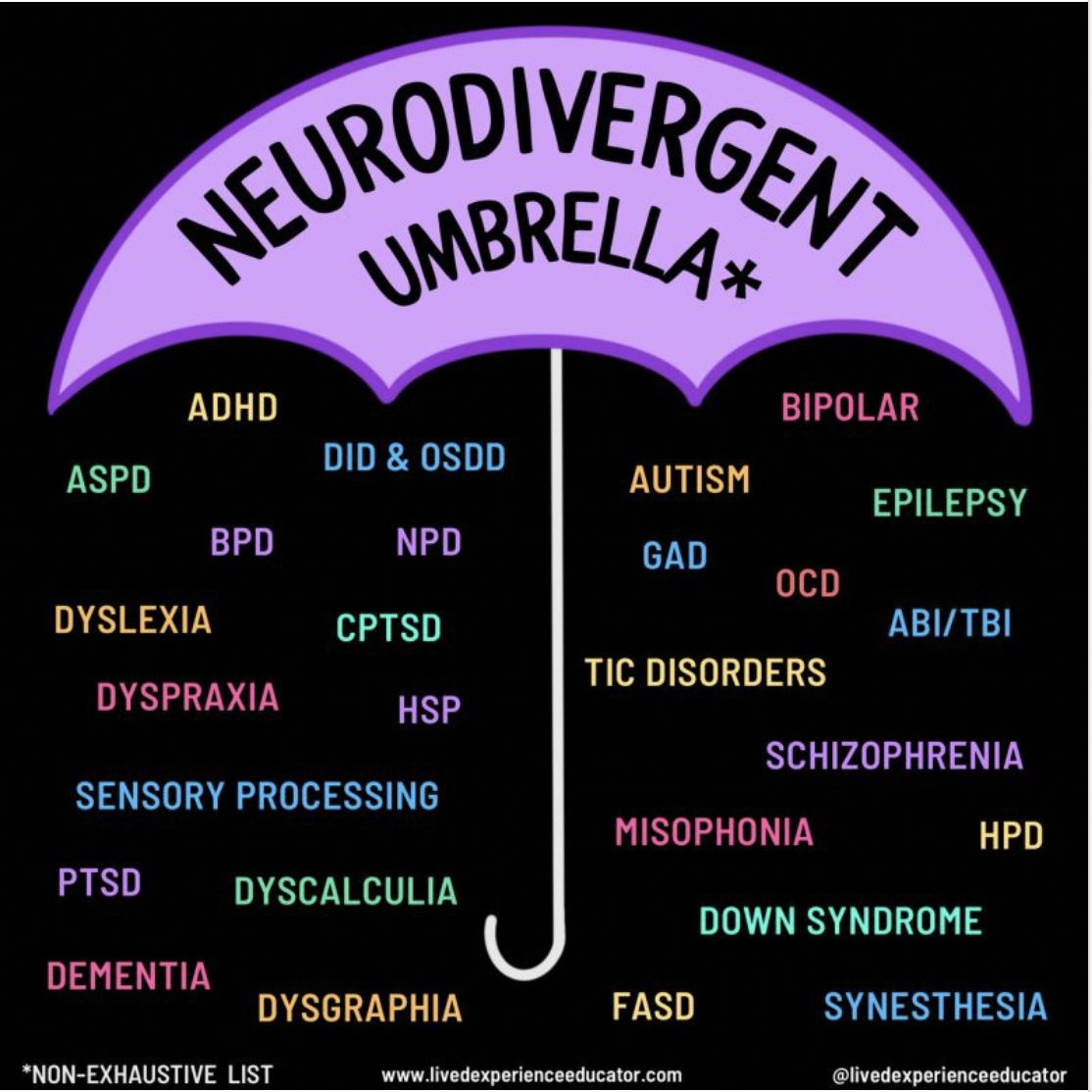
The Neurodivergent Umbrella by Sony J Wise
This is the Neurodiversity Umbrella, created by Sonny J Wise, a lived experience educator in Australia. They are clear when they talk about this umbrella that it is expansive, and that neurodiversity is by no means limited to the words in this image.
Do you see yourself here? Do you see family members, friends, colleagues, bosses? I would hazard a guess that you do, whether you know it or not is another question entirely.
Some Statistics
This sociopolitical identity is one that is gaining more awareness. People all over the place are starting to recognize their neuro-difference and realizing that they can't keep trying to cosplay as typical. It’s costing too much. Folks who have known of their neurodivergence for their whole lives are shifting to seeing it as difference, not disorder. Still others, who have been tirelessly advocating for this change for decades now, are starting to see the conversation catch on in the wider world.
According to the October Health 2025 Report, 10.83% of the Canadian population is neurodivergent. This number is likely a conservative estimate, and as far as I can tell doesn’t represent the entire Neurodivergence Umbrella.
This conversation is especially relevant to the 2SLGTBQ+ community because of the tendency towards overlap between neurodivergence and queerness.
Between 30% and 70% of neurodivergent humans also identify as queer.
Autistic people are 3 times more likely to be gender diverse than the average population.
There is so much overlap that in 2008 Dr. Nick Walker coined the term neuroqueer to describe a person who is on the journey to explore how their queerness and neurodivergence overlap and influence each other.
Gender diversity and neurodivergence tend to go hand in hand. We as a queer collective have more neurodivergence represented among us than the total population. Abandoning any part of our group to the assimilation of society is a betrayal of our queer history. We are here at this conference because we all share the goal of seeing and supporting queerness in the workplace. We are championing our rights to making a life and making a living that has space for all of who we are. This goal cannot be accomplished without seeing and supporting neurodivergence as well.
So how do we go about making good on this support? One path is through accommodation, making space for these different ways of thinking and being in how we do things.
Accommodations
Decades ago urban planners began including curb cuts in their paving of side walks. These dips in the edge of the concrete that connected crosswalks to sidewalks were fiercely advocated for by physically impaired folks who required the use of a wheelchair for mobility, particularly at Berkley in California. Students there pushed tirelessly for the right to access spaces on campus. The curb cuts were added as an accommodation for this group of humans who otherwise struggled to access something that physically abled people took for granted, crossing the street.
But something important happened when the curb cuts were included. This accommodation made travelling by side walk better for more than the intended recipients. Humans with canes and walkers, for whom stepping up was an extra burden, were aided. Parents with strollers and wagons for their children were aided. Delivery workers with dollies were aided. Hell, anyone who had anything that rolled along the ground with them suddenly had access to sidewalks without needing to wrestle with a right angle. The accommodation, intended for one group of people, made the world more accessible for everyone. This was so impactful that it is now called ’the curb cut effect’ when a support intended for one group of people ends up benefitting many.
The exact same can be true of accommodation for neurodivergence.
Things like giving clear, written instructions/expectations in plain language, lessening the sensory load on people by moving away from florescent overhead lighting, or instituting flexible work hours, these things can help everybody.
Now I can’t speak for your specific circumstance, and my neurodivergence makes in challenging to make general recommendations without feeling like I might be leading you astray. Shifts in the way your team or community works must be made in consultation with your actual team and community, taking into account the unique needs of the neurodivergence in your room. To borrow a phrase from the Disability Justice movement, nothing about us without us.
Instead I will ask you, what are you doing to ensure your team has what they need to succeed? When you ask, 'what do you need?', are you prepared to listen? And if your neurodivergent team members aren't sure what they need, are you prepared to support them as they find out? What accommodations are you avoiding because they would mean ‘doing things too differently’ when they could be the way forward for everyone?
Conclusion
I want to leave you with two final thoughts, intended for two different groups of people.
The first is for all my neurodivergent darlings who are reading, I hope you take this to heart: My sibling in neurotype, your neurodivergence does not make you bad, stupid, wrong, or broken. Full Stop.
For everyone else, take this is an invitation to start seeing the difference in our ways of thinking and being as yet another way the diversity of humanity is put on display. We are asked to work with that diversity instead of against it, to assume competence, and to fight for the liberation of all in our quest for the liberation of ourselves.
In the words often credited to Lilla Watson:
“If you have come here to help me you are wasting your time. If you have come here because your liberation is bound up with mine, then let us work together.”
- “Aboriginal activists group Queensland, 1970s”.